The Hidden Cost of Off-the-Shelf: 5 Places SaaS Quietly Breaks as You Scale
By Fifth Corp
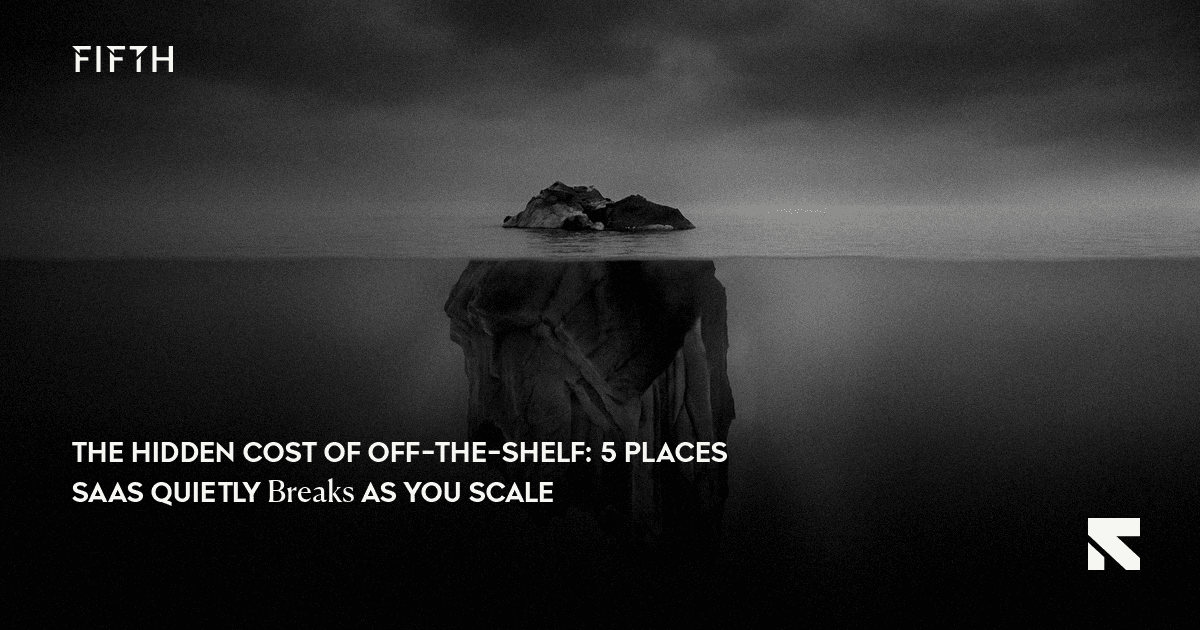
Off-the-shelf software rarely fails. It just quietly stops fitting.
There's no alarm when you outgrow your tools. Nothing crashes. The subscription renews, the login works, the dashboard loads. What changes is subtler and more expensive: the software slowly stops matching how you actually work, and your team quietly absorbs the difference.
That absorption is the hidden cost of off-the-shelf. It doesn't show up on an invoice. It shows up as extra headcount, manual steps, shadow spreadsheets, and a ceiling on how fast you can move. By the time it's visible in the numbers, you've been paying it for a year.
We see the same pattern across almost every growing company. Here are the five places generic software quietly breaks as you scale—and what the workarounds actually cost.
1. The data model was built for someone else's business
Every SaaS tool has an opinion about how the world works, baked into its data model. A CRM assumes a certain shape of "contact," "deal," and "pipeline." A project tool assumes a certain shape of "task" and "project." That opinion is fine—until your business has a shape the tool doesn't recognize.
Maybe your customers aren't individuals but multi-party accounts. Maybe a "project" in your world has phases the tool can't represent. Maybe the relationship between two things—a property and a tenant, an order and a subscription—is central to your business and invisible to the software.
When the data model doesn't fit, you improvise. You overload a "notes" field to store structured information. You use tags as a workaround for a relationship the tool doesn't support. You maintain a spreadsheet on the side because the tool literally cannot represent the thing you need to track.
What it costs: every report becomes unreliable, because the real data lives in three places. Every new hire needs to learn your undocumented conventions. And the workaround gets more fragile the more you scale, because you're building complexity on top of a foundation that was never meant to hold it.
2. Reporting answers the vendor's questions, not yours
Off-the-shelf dashboards are built around the metrics the vendor decided most customers want. They look impressive in a demo. Then leadership asks a specific question—"what's our margin by segment, by channel, over the last two quarters?"—and the tool can't answer it.
So someone exports the data. Then someone else exports data from a second tool. Then the two get stitched together in a spreadsheet, cleaned by hand, and turned into the report that leadership actually uses to make decisions. That spreadsheet becomes the real reporting system. The expensive SaaS dashboard becomes decoration.
What it costs: the most important decisions in the business run on a hand-built artifact that one person maintains, that breaks when they're on leave, and that carries whatever errors crept in during the manual stitching. You're not short on data. You're short on the ability to ask your own questions of it.
3. The workflow only fits if you change how you work
Generic software encodes a generic workflow. When your process matches, that's a gift—you get a proven way of working for a subscription fee. When it doesn't, the tool starts dictating your operations instead of supporting them.
You've felt this if you've ever heard "we can't do it that way because the system won't let us." That sentence is the moment the software started running the business instead of the other way around. The workflow that made you distinctive—the faster path, the smarter sequence, the step competitors don't do—gets flattened into whatever the tool supports.
What it costs: you lose the edge that off-the-shelf can't see. Worse, you train an entire team to work in the tool's shape, so the mismatch gets baked into habits and onboarding. The longer it runs, the more expensive it is to unwind.
4. The integrations are "supported"—until they aren't enough
Most SaaS tools advertise integrations, and for simple cases they work. The trouble starts when your integration needs get specific. The native connector syncs some fields but not the one you need. It fires on the wrong trigger. It handles the happy path but not the exception that actually matters to your business.
So you bridge the gap. Maybe with a middleware tool, maybe with a manual export-import routine someone runs every morning, maybe with a fragile automation held together by hope. Each of these is fine in isolation. Stacked together across five tools, they become a hidden integration layer nobody designed, nobody documented, and nobody fully understands.
What it costs: this improvised connective tissue is where scaling businesses lose the most time and trust. It breaks silently. Data goes stale without anyone noticing. And every new tool you add multiplies the number of brittle connections you have to maintain. The tools were cheap; the seams between them are where the real cost lives.
5. You don't own the ceiling
The most strategic limitation is the one you feel last: with off-the-shelf, someone else controls what's possible. The vendor decides the roadmap, the pricing tiers, the limits, and what happens to features you depend on. You can request. You can't build.
For commodity functions, that's a fair trade—you don't want to own the roadmap for your email client. But when a tool sits on your core workflow, being unable to change it becomes a real constraint. You want to add a step the tool doesn't allow. You want a rule the vendor hasn't built. You want to move faster than their release cycle. And you can't, because you're a tenant in someone else's software.
What it costs: your ability to differentiate gets capped at whatever the vendor offers everyone else. If the tool runs a commodity, fine. If it runs your edge, you've handed your ceiling to a company whose priorities aren't yours.
The pattern underneath all five
Notice what these have in common. None of them is a bug. The software is working as designed. The problem is that the design was never yours. Off-the-shelf software is built for the average of a thousand companies, and the more distinctive your business, the further you sit from that average—so the further your team has to stretch to close the gap.
That stretch is invisible on the balance sheet, which is exactly why it's dangerous. Nobody approves a project called "absorb the mismatch between our business and our tools." It just accumulates, one workaround at a time, until you're running a real business on a system that quietly doesn't fit.
Our perspective
The answer isn't to rip out every SaaS tool and build everything custom. That's the opposite mistake, and it's just as expensive. Commodities should stay off-the-shelf. The point is to see the costs clearly and put custom effort exactly where the mismatch is worst—usually the workflow that is your actual edge.
At FIFTH, that's the line we help clients draw. Keep the commodity tools. Replace or extend the ones sitting on your core process. Design the integration layer on purpose instead of letting it accumulate by accident. The goal isn't more software. It's a system that fits how you actually work—so your team stops paying the hidden cost of one that doesn't.
Where to start
You don't need a big audit to find your version of these five. Ask your team one question: "Where do you work around the software instead of through it?" The answers are your map. Every workaround is a place the tool stopped fitting—and a place worth measuring before it scales into something much more expensive.
If those answers are starting to add up, that's the conversation we have with clients before deciding what to keep, extend, or replace. We're glad to have it with you.