
CRM Automation That Sales Actually Uses: Scoring, Follow-Up, Handoffs
By Fifth Corp
Most sales teams do not have a CRM problem. They have a CRM that nobody uses.
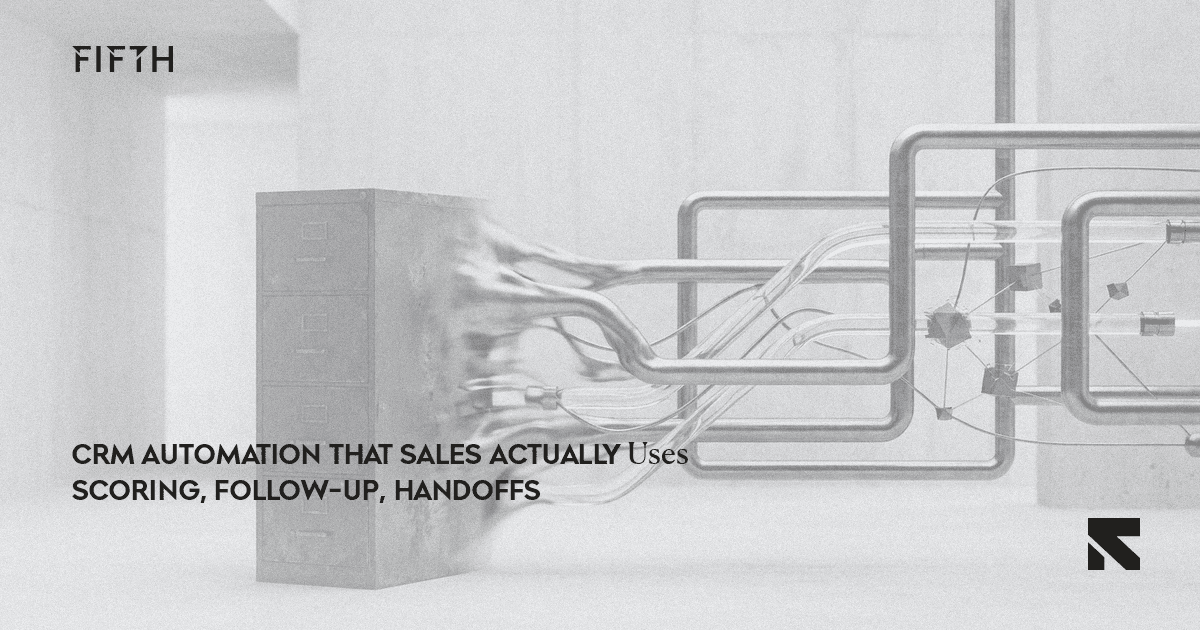
The software is paid for. The pipeline stages are set up. Someone spent a weekend importing contacts. And within a few months, the reps are back in their inboxes, their notebooks, and their memory. The CRM has quietly become a filing cabinet — a place data goes to sit, not a system that moves work forward.
This is the gap most businesses miss. Buying a CRM is not the same as running on one. A CRM only creates value when it does work the team would otherwise do by hand: deciding which lead matters, chasing the ones that go quiet, and making sure nothing falls through the cracks between marketing, sales, and delivery.
That is what CRM automation for small business is actually for. Not more fields. Not more dashboards nobody opens. Work that happens on its own.
Why Most CRMs End Up Unused
The usual story is familiar. A team adopts a CRM to "get organized." They configure it to mirror how they already work — manual data entry, manual follow-up, manual updates. Nothing about the daily job changes, except now there is an extra place to log things.
So reps do the math. Updating the CRM takes time and gives them nothing back. Skipping it costs them nothing today. The system decays. Records go stale. Leaders lose trust in the pipeline because half of it is out of date.
The root issue is not the tool or the team. It is that the CRM was set up to store information instead of to act on it. A system that only records is a system people abandon. A system that does something useful — reminds, routes, scores, drafts — is a system people rely on.
The Shift: From Filing Cabinet to Working System
There are three jobs a CRM should quietly handle so that a small sales team can focus on conversations instead of admin. Get these three right and the CRM stops being a chore and starts being infrastructure.
- Scoring — deciding which leads deserve attention now.
- Follow-up — making sure no interested lead goes cold from silence.
- Handoffs — moving a lead cleanly between people and stages without dropped context.
None of these require a large enterprise platform or a heavy budget. They require the CRM to be wired around how the business actually sells, rather than around a generic template. Let's break down what each one looks like in practice.
Lead Scoring: Deciding What Matters Before a Human Looks
When every lead lands in one undifferentiated list, reps default to whatever is loudest or most recent. The best opportunity of the week can sit untouched simply because it arrived on a busy Tuesday.
Lead scoring automation fixes the triage problem. Instead of a rep guessing, the CRM assigns each lead a priority based on signals the business already cares about — company size, budget indicators, the service they asked about, how they found you, whether they opened the last three emails, whether they booked a call.
The point is not a perfect algorithm. The point is direction. A well-scored pipeline tells a small team where to spend their limited hours first. A hot lead gets surfaced to the top and flagged for immediate contact. A weak-fit lead gets routed into a slower nurture track instead of eating a rep's morning.
Done right, scoring is invisible to the customer and obvious to the team. The rep opens the CRM and already knows who to call. That is the difference between a system that thinks and a list that just sits there.
Follow-Up: The Money Most Businesses Leave on the Table
Ask any founder where deals quietly die, and the honest answer is usually the same: follow-up. A lead shows interest, gets one reply, then hears nothing for two weeks because the rep got busy. By the time someone remembers, the lead has gone cold or signed with whoever stayed in touch.
Sales follow-up automation is the highest-leverage thing a small business can wire into its CRM. Not spammy blasting — sequenced, relevant, human-feeling contact that happens whether or not anyone remembers to send it.
In practice this looks like:
- A new inquiry gets an immediate acknowledgment, not a next-day reply.
- A lead who went quiet after a proposal gets a gentle nudge on day three, then again on day seven.
- A rep gets an automatic task reminder when a promised follow-up date arrives.
- A lead who re-engages — opens an email, revisits the site — gets flagged back to the rep as warm again.
The automation carries the persistence that humans lose when they get busy. And critically, it keeps a human in the loop: the system drafts and reminds, but the rep still owns the relationship and the judgment. Automation should make the follow-up reliable, not robotic.
Handoffs: Where Context Goes to Die
The third silent killer is the handoff. Marketing captures a lead and passes it to sales. A rep closes a deal and passes it to the delivery team. A junior qualifies an inquiry and passes it to a senior. Every one of these moments is a chance to lose context — and most teams lose plenty.
The customer feels it immediately. They repeat information they already gave. They get asked questions they already answered. They sense that the left hand does not know what the right hand promised. Trust erodes before the work even starts.
Clean handoffs are a system design problem. The CRM should carry the full context with the lead as it moves — the source, the conversation history, the scoring, the promises made, the next step owed. When a lead is routed to a new owner, that person should inherit everything, automatically, without a Slack scramble or a lost email thread.
Automated handoffs also enforce accountability. When a lead moves to a new stage, the system assigns the new owner, sets the next task, and notifies the right person. Nothing sits in limbo waiting for someone to notice it. The pipeline keeps moving because the system keeps it moving.
How FIFTH Thinks About CRM Automation
At FIFTH, we do not start with the CRM. We start with how the business actually sells — where leads come from, how they get qualified, where they stall, who owns what, and where deals quietly leak out of the pipeline.
Only then do we decide what the CRM should do. Sometimes that means automating scoring and follow-up inside a tool the client already pays for. Sometimes it means connecting the CRM to the rest of the business — the website, the inbox, the reporting layer — so information stops living in silos. The goal is never more software. It is a system the sales team actually uses because it makes their day easier, not heavier.
This is the core idea behind everything we build: your business does not need more tools. It needs a better system connecting the ones you have. A CRM is only as valuable as the work it takes off your team's plate.
What Good Looks Like
You will know the CRM has become a working system when a few things change. Reps open it first thing because it tells them who to call. Follow-ups stop depending on memory. Leaders trust the pipeline because it reflects reality. And leads stop disappearing in the gaps between people.
None of that comes from a bigger platform or a longer list of features. It comes from wiring three jobs — scoring, follow-up, handoffs — into the way the team already works, so the software carries the weight instead of the people.
A CRM that only stores data will always drift back into a filing cabinet. A CRM that does the work becomes the thing the business runs on.
If your CRM has quietly become a place data goes to sit, it may be time to make it do the work instead. FIFTH designs and builds CRM and workflow automation around how your team actually sells — so the system earns its place. To see how this applies to your pipeline, speak to FIFTH.