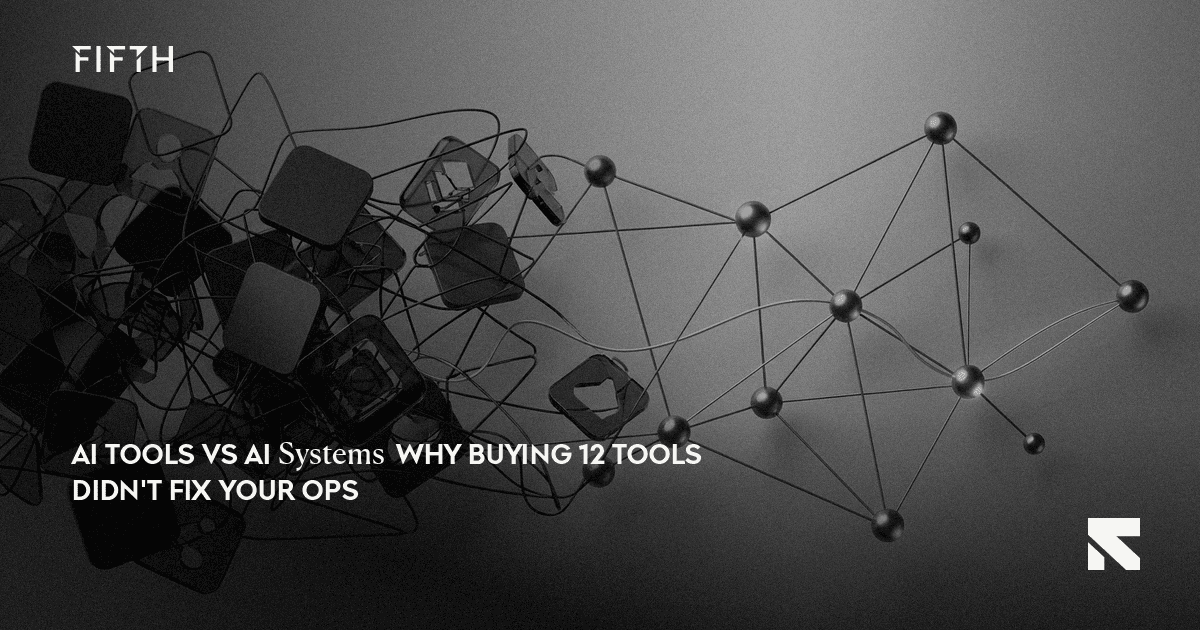
AI Tools vs AI Systems: Why Buying 12 Tools Didn't Fix Your Ops
By Fifth Corp
Your team has a tool for everything. A tool for scheduling. A tool for notes. A tool that "uses AI" to draft replies. Another that summarizes calls. Three months ago someone added a fourth to fix what the third one missed. And yet, if you're honest, your operations don't feel meaningfully faster. They feel busier.
This is one of the most common conversations we have with founders and operations leads. They didn't under-invest. They over-bought. Somewhere along the way, "adopt AI" quietly became "subscribe to more software," and the result is a stack of twelve tools that each do one clever thing and none of which talk to each other.
The problem isn't the tools. It's that a pile of tools was never going to become a system on its own.
The gap nobody sold you on
Every tool you bought was sold as a solution. In isolation, most of them work. The AI note-taker really does transcribe the call. The scheduler really does book the meeting. The problem lives in the space between them — the handoffs.
A tool does a task. A system runs a process. That distinction sounds academic until you watch how work actually moves through your business. A lead comes in. Someone copies it from the form into the CRM. Someone else checks whether it's a real opportunity. A note gets written. A follow-up gets scheduled. A proposal gets drafted. An invoice eventually goes out. Each of those steps might have a tool. But the connective tissue — the moving, checking, routing, and remembering between steps — is still a human doing manual work, or worse, not doing it and letting things slip.
That's the difference at the heart of ai tools vs ai systems. Tools are the individual instruments. A system is the thing that makes them play together in the order your business actually needs.
Why this got worse, not better
It's tempting to think more AI would close the gap. In practice, the last two years made it wider.
The barrier to launching an AI feature collapsed. Every SaaS product bolted "AI" onto its interface, and every one of them wanted to own a slice of your workflow. So you didn't get one intelligent system — you got a dozen intelligent islands, each holding a piece of your data hostage in its own login.
Now your information is scattered. The context your sales tool has, your delivery tool can't see. The insight buried in your support inbox never reaches the person building next quarter's roadmap. Your team spends its day being the integration layer — the human glue moving data between systems that were never designed to meet. You automated tasks and accidentally created a new full-time job: managing the tools that were supposed to save you time.
This is why buying more rarely helps. You can't subscribe your way to a connected operation. Connection is something you have to design.
What a system actually looks like
At FIFTH, we start from a simple belief: your business doesn't need more tools — it needs a better system. A system isn't a bigger stack. It's usually a smaller, tighter one, built around how your business actually runs rather than how a dozen vendors want you to run.
A real system has a few properties your tool pile doesn't:
One flow of truth. Data enters once and moves through the process automatically. The lead captured at the top is the same record that triggers the follow-up, populates the proposal, and updates the dashboard. Nobody re-types anything.
Logic that matches your business. The rules for what happens next — who gets routed where, what needs approval, what can run untouched — reflect your operation specifically, not a generic template. This is the part no off-the-shelf tool can give you, because no vendor knows your business.
Human checkpoints where they matter. A good system doesn't remove people. It removes the mindless parts and keeps humans exactly where judgment is needed — approving the exception, reviewing the edge case, making the call that shouldn't be automated.
Visibility. You can see the whole process in one place. Where work is, what's stuck, what's moving. Twelve tools give you twelve dashboards, which is the same as having none.
We've built this shape repeatedly. On a PropTech platform like Proptely, the value wasn't any single feature — it was that property, client, and transaction data moved through one connected environment instead of five disconnected apps. On a content and marketing automation platform like ZYR, the point was never "an AI writing tool." It was an end-to-end system where planning, production, and publishing ran as one flow. The tools mattered less than the wiring between them.
How to tell which one you have
You don't need an audit to diagnose this. A few honest questions do it.
How many times does the same piece of data get entered? If a client's name lives in four places and someone updates it in four places, you have tools, not a system.
What breaks when one person is out? If a process only runs because someone knows to copy this into that, the process lives in a person's head, not in your operation.
Can you see the whole workflow in one view? Or do you assemble the picture by opening five tabs and asking two people?
When something goes wrong, do you know where? In a system, you can trace it. In a tool pile, you guess.
If those answers sting a little, that's normal. Almost every growing business hits this wall. It's not a failure of discipline. It's the predictable result of solving problems one tool at a time.
The FIFTH perspective
We're not against tools. We use plenty, and so should you. What we're against is mistaking a shopping list for an operation.
The reason we work as an embedded partner rather than handing over software and leaving is that connecting a business is not a one-time build — it's a design problem that has to understand your actual workflow first. We map how work really moves through your business, find the handoffs that are quietly costing you, and then design a system around them. Sometimes that means custom software. Sometimes it means automation stitching your existing tools into something coherent. Usually it's a mix. The deliverable is never "another tool." It's an operation that runs.
That's a different relationship than buying a subscription. A tool is something you rent and manage. A system is something you own and run on.
The one thing to take away
Adding tools feels like progress because each one closes a visible gap. But gaps between tools are invisible, and that's where your operation actually leaks — in the handoffs, the re-typing, the things that slip when a person forgets.
You will not fix that by buying a thirteenth tool. You fix it by stepping back and asking what system your business should be running on, then building toward it deliberately. Fewer, better-connected parts beat more, smarter-but-separate ones every time.
If your stack has grown faster than your clarity — if you're managing tools instead of running an operation — it's worth mapping what you actually have before adding anything else. We're happy to walk through that with you and show you where a system would replace the busywork. No pitch for another tool. Just a clearer picture of what your business could run on instead.